Categories
Adventuring

(nr) St Agnes, 2014

Categories
Reviewing

‘The real objective is a greater life.’ Notes from Roberto Unger: The Progressive Agenda Now

Solidarity mural
Hands in Solidarity, Hands of Freedom mural on the side of the United Electrical Workers trade union building on West Monroe Street at Ashland Avenue in Chicago, Illinois. (BY-NC-ND 2.0 Terence Fairclough)

Roberto Unger is a Professor of Law at Harvard. He taught Barack Obama back in the day, and apparently urged Americans to reject Obama’s bid for a second-term. Ouch.

He’s also advised progressive movements and parties around the world – and he served in President Lula’s government in Brazil. Great lefty credentials. Huge Wikipedia bio here.

He spoke at LSE last week and was in the UK to lecture, sell books and talk with Ed Miliband (more on whom later).

Categories
Adventuring

Oxford, Summer 2013

More here.

Categories
Thinking

McCullin

http://youtu.be/GjCfP-F58MY

The full film is extraordinary. An amazing man, and an amazing life. The quiet power of it all – the photos, his commentary – is overwhelming.

Categories
Thinking

“Let them – let them read my frigging email. Because I’m going to belong to the real world.”

Brilliant, hilarious talk from fast-talking Douglas Rushkoff, on what digital media does to us, our perception of time, our institutions, the way we work, and what it does to our democracy.

http://www.youtube.com/watch?v=oG0VMwfks8Y

Interrupted by the NSA/PRISM breaking news story just before going on stage, Rushkoff talks of the ‘perpetual state of interruptive emergency’ that digital media encourages us to live in: ‘present shock’. What appears to be a pessimistic talk – he even complains about Game of Thrones – is turned around as Rushkoff dreams of a culture of activism.

I’m not convinced his position is really consistent – I’m not sure you can complain about the Obama campaign just using digital for fundraising, about nobody having goals anymore, before claiming a bright future of local a peer-to-peer economy and always-on activism: I don’t see how the latter creates longer-term goals either. But it’s still a great watch.

Salim ‘Singularity University’ Ismael’s talk from the same forum is also excellent – some ‘wow’ statistics in here:

http://www.youtube.com/watch?feature=player_embedded&v=zQukT2ZF-3Q

Categories
Thinking

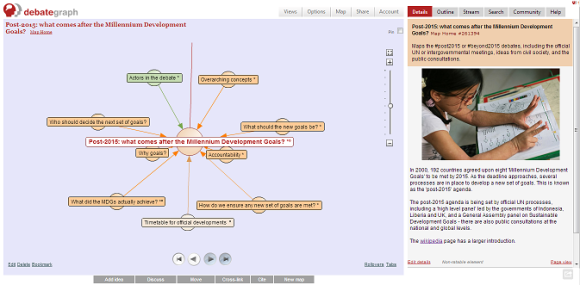
Mapping the post-2015 development debate – join in!

The post-2015 development agenda debate is generating a lot of words on what should follow the popular Millennium Development Goals (or MDGs) come 2015, which is the point at which they were supposed to have been met. There are hundreds of international meetings going on, as well as global and national consultations, plenty of think-tank reports, op-eds and news coverage. 

But for someone who’s interested in the discussion – and how decisions are being taken – it’s hard to keep up with what’s going on. So, inspired by an earlier effort by Jan Goossenaerts, I’ve started a new graph of the debate. It tries to bring disparate strands of the debate together in one place.

Debategraph
Mapping the post-2015 development debate

This is just a start. There is a vast amount of information missing. I’ve mainly based it so far on stories from my twitter timeline – there are many more voices out there, particularly in developing countries.

I have so far only mentioned a few specific goal suggestions – those made in Save the Children’s recent report. There must be more to add. And although it does seem like there will be a new set of goals (perhaps up to 2030), there is still room for a debate as to whether goals are the right tactic for improving global outcomes, or whether there are other ways of approaching the agenda.

There is also much to be discussed in terms of delivery and accountability. If the world isn’t going to meet the Millennium Development Goals by 2015, what’s to say any new goals will be met?

So join in. Anyone can edit the graph above. Debategraph is a fantastic tool, which allows many layers of debate, critique and argumentation. Give it a go: sign up, navigate back to the post2015 map and start adding material, links, or refining what’s already there.

Categories
Reading

Tapscott vs Shirky (from Frog Design)

Selected quotes from a conversation between Don Tapscott (author of Wikinomics, prof. at Rotman) and Clay Shirky (author of Here Comes Everybody, Cognitive Surplus) in Frog’s corporate magazine ‘Design Mind‘.

Tapscott:

“The more appropriate metaphor for the growing loss of privacy today would be Frank Kafka’s The Trial, where the central character awaits trial and judgment from an inscrutable bureaucracy for a crime that he is not told about, using evidence that is never revealed to him, in a process that is equally random and inscrutable. Similarly, we could become the targets of social engineering, decisions and discrimination. And we will never really know what, or why…