Categories
Thinking

McCullin

The full film is extraordinary. An amazing man, and an amazing life. The quiet power of it all – the photos, his commentary – is overwhelming.

Categories
Thinking

“Let them – let them read my frigging email. Because I’m going to belong to the real world.”

Brilliant, hilarious talk from fast-talking Douglas Rushkoff, on what digital media does to us, our perception of time, our institutions, the way we work, and what it does to our democracy.

Interrupted by the NSA/PRISM breaking news story just before going on stage, Rushkoff talks of the ‘perpetual state of interruptive emergency’ that digital media encourages us to live in: ‘present shock’. What appears to be a pessimistic talk – he even complains about Game of Thrones – is turned around as Rushkoff dreams of a culture of activism.

I’m not convinced his position is really consistent – I’m not sure you can complain about the Obama campaign just using digital for fundraising, about nobody having goals anymore, before claiming a bright future of local a peer-to-peer economy and always-on activism: I don’t see how the latter creates longer-term goals either. But it’s still a great watch.

Salim ‘Singularity University’ Ismael’s talk from the same forum is also excellent – some ‘wow’ statistics in here:

Categories
Thinking

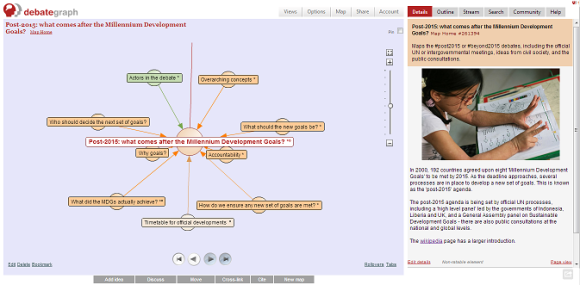
Mapping the post-2015 development debate – join in!

The post-2015 development agenda debate is generating a lot of words on what should follow the popular Millennium Development Goals (or MDGs) come 2015, which is the point at which they were supposed to have been met. There are hundreds of international meetings going on, as well as global and national consultations, plenty of think-tank reports, op-eds and news coverage. 

But for someone who’s interested in the discussion – and how decisions are being taken – it’s hard to keep up with what’s going on. So, inspired by an earlier effort by Jan Goossenaerts, I’ve started a new graph of the debate. It tries to bring disparate strands of the debate together in one place.

Debategraph
Mapping the post-2015 development debate

This is just a start. There is a vast amount of information missing. I’ve mainly based it so far on stories from my twitter timeline – there are many more voices out there, particularly in developing countries.

I have so far only mentioned a few specific goal suggestions – those made in Save the Children’s recent report. There must be more to add. And although it does seem like there will be a new set of goals (perhaps up to 2030), there is still room for a debate as to whether goals are the right tactic for improving global outcomes, or whether there are other ways of approaching the agenda.

There is also much to be discussed in terms of delivery and accountability. If the world isn’t going to meet the Millennium Development Goals by 2015, what’s to say any new goals will be met?

So join in. Anyone can edit the graph above. Debategraph is a fantastic tool, which allows many layers of debate, critique and argumentation. Give it a go: sign up, navigate back to the post2015 map and start adding material, links, or refining what’s already there.

Categories
Thinking

Avaaz hits 20m members, Beppe Grillo, and digital lessons for political parties

Aside from an no-new-news Observer interview with co-founder Ricken Patel, Avaaz hasn’t shouted about its milestone of 20m members. According to the Observer, these members make Avaaz the world’s biggest online campaign group. You have to admire their out-of-nowhere exponential growth:

Avaaz growth curve
Avaaz’s growth curve, from an Avaaz email (note additional 2.5m in just a few months)
Categories
Thinking

Reimagining global democracy – the slideshare version

Here’s a quick version of my MA Global Governance paper on global democracy. It’s the same story, but with few words and many photographs. Cos that’s how the internet likes it.


Categories
Thinking

It’s friday: watch videos!

1. Pixels: I stumbled upon this again recently. It’s astoundingly well-produced. Brilliant sound too.

https://vimeo.com/10829255

Categories
Thinking

Parliament Everywhere: designing a legislature for the 21st century

Parliaments are in trouble. Invented – in the form we know them – nearly 800 years ago to prevent the abuse of executive power, they struggle today to meet same goal. In the 21st century, executive power is no longer exercised from neat, single locations that are reflected in legislatures. If the democratic control of power is to be reasserted, alternative democratic innovations must be considered. This post looks at such potential innovations – and considers some of arguments for why they’re necessary. It argues that the location-less nature of the Internet may suggest a solution in the form of a multi-layered platform – a ‘parliament everywhere’.